AI’s “iPhone Moment”: What IT Investors Must Learn from the Structural Shift
Feb 12, 2026
Summary
AI’s iPhone moment threatens IT services; markets ignore disruption and extinction risks ahead soon.
Artificial intelligence may be approaching its “iPhone moment” — a sudden, irreversible shock that doesn’t just improve an industry, but fundamentally rewrites how it operates.
In 2007, the iPhone didn’t make better phones.
It destroyed entire business models — Nokia, BlackBerry, Windows Mobile.
Today, the concern is that AI could do the same to enterprise software and IT services.
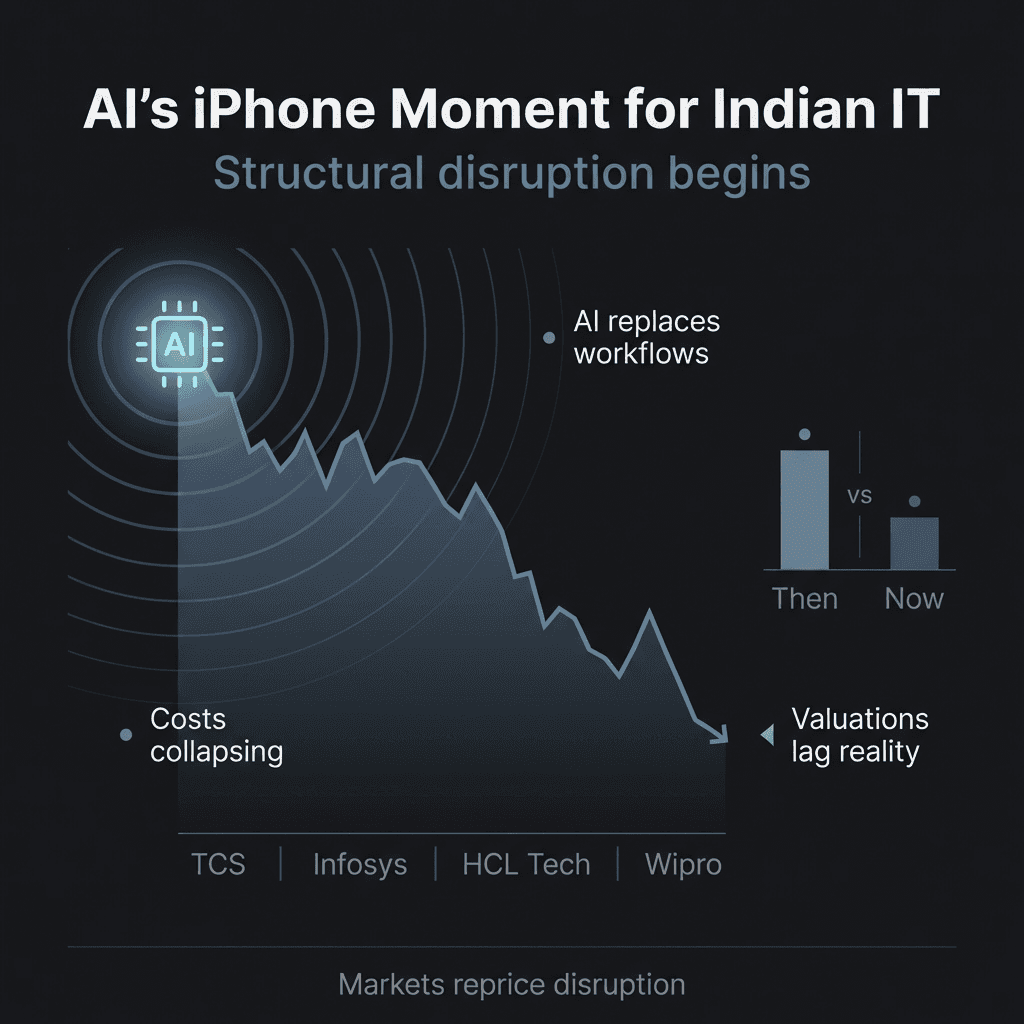
For investors in Indian IT majors like TCS, Infosys, HCL Tech, and Wipro, this is not just a technology trend. It may be a structural reset of the industry’s economic model.
The Parallel: From Smartphone Disruption to AI Disruption
In 2007, incumbents dismissed the iPhone as a consumer toy. They believed they “owned the enterprise.”
Today, many IT services leaders view AI as a productivity tool — something to integrate, not something that replaces them.
But the shift underway is deeper.
AI is moving from being a helper to becoming a direct substitute for human labor — especially in high-volume, process-driven work that has historically powered IT services and BPO revenue.
That’s why the comparison to the iPhone era is gaining traction.
The Trigger: The “SaaSpocalypse” Moment
Recent market panic was sparked by Anthropic’s Claude Cowork release, which introduced specialized AI plugins for legal, sales, marketing, and data analysis.
These systems can execute multi-step enterprise workflows end-to-end.
What changed?
NDA reviews
Compliance checks
Data analysis
Sales workflows
Tasks that once required teams can now be handled by AI agents.
The economic shock
Projects that previously cost $60,000+ may now be executed via AI subscriptions costing $30–40 per month.
That is not productivity improvement.
That is cost structure collapse.
Markets reacted accordingly — triggering a structural sell-off across enterprise software stocks.
Wedbush’s Dan Ives described it as “unlike anything in 25 years.”
The Value Trap: When “Cheap” Isn’t Safe
History offers a warning.
In 2011, analysts called BlackBerry “absurdly cheap” at low-teens P/E.
It wasn’t cheap. It was becoming irrelevant.
During the 2015–2017 cloud transition, Indian IT stocks bottomed at:
TCS → 16.3x
Infosys → 13.9x
Wipro → 12.5x
HCL Tech → 13.1x
That disruption was milder than AI.
Yet today — despite slower growth and higher structural risk — many IT stocks still trade at 24–30x P/E.
This is the valuation paradox:
greater disruption, but higher multiples.
Why This Sell-Off Matters
This isn’t normal market volatility.
It resembles early 2007:
iPhone launches
Incumbent stocks initially hold up
Real damage appears years later
Markets may now be pricing long-term business model erosion, not short-term earnings risk.
The Lesson Investors Keep Forgetting
What incumbents said in 2007:
“Competition is good”
“We’re well positioned”
“This expands the ecosystem”
What actually happened:
Profit pools shifted
Market share stopped mattering
Cheap valuations got cheaper
Entire industries vanished
The key lesson:
👉 Being cheap does not protect you from extinction.
SaaS vs Indian IT: A Valuation Mismatch
Today’s SaaS companies:
Strong revenue growth
Strong margins
Trading at low-teens P/E (priced for disruption)
Indian IT companies:
Slower growth
Lower margins
Direct exposure to AI substitution
Yet trading at higher multiples
Markets appear to be pricing risk correctly in SaaS — but not in IT services.
Structural Disruption: Labor vs Agents
The traditional IT services model depends on:
headcount scaling
billable hours
long-duration contracts
AI agents challenge all three.
If one AI system replaces the output of multiple junior engineers, the “army of developers” model becomes economically fragile.
Revenue may continue.
But margin structure and valuation logic change.
The Denial Phase
Disruption cycles often follow a pattern:
Incumbents dismiss the threat
Business model pressure appears gradually
Markets reprice before earnings collapse
Many IT leaders today claim they are well positioned for AI.
History suggests management is often the last to recognise structural threats.
Disruption vs Extinction
Not every company disappears during technological shifts.
But survival does not guarantee shareholder returns.
If firms cannot move from:
selling hours → selling outcomes
labor arbitrage → AI-driven solutions
even historically “cheap” valuations may not offer safety.
Strategic Implications for Investors
The market is re-rating the entire software ecosystem.
The key risk is not earnings decline — it is economic model redesign.
Investors should watch for:
Clear AI-driven revenue streams
Stable margins despite automation
Outcome-based pricing models
Valuations reflecting disruption risk
Companies priced for a stable past may face the biggest adjustment.
The Bottom Line
AI is not just improving productivity.
It is redefining how software and services are delivered, priced, and scaled.
That makes this a structural transition — not a cyclical one.
CEO commentary is unreliable during paradigm shifts
Historical valuation anchors may no longer apply
Indian IT is not yet fully priced for disruption
The industry may survive.
But valuation multiples, profit pools, and competitive dynamics are already shifting.
For investors, this is not a “buy vs sell” story.
It is a “who adapts — and who gets replaced” story.
Turn insights into informed decisions
Explore research-backed model portfolios and curated stock ideas to make smarter portfolio decisions.
Start Investing