Indian IT’s AI Pivot: As GCC Count Crosses 2,000, A Structural Shift Is Underway
Feb 11, 2026
AdvisorAlpha
Summary
India’s IT pivots to AI via GCC surge, but margins may reset for incumbents.
Union Minister Ashwini Vaishnaw says Indian IT is transitioning from manpower-led services to AI-led services — powered by GCCs and data centre infrastructure. But what does this mean for investors?
On February 7, 2026, Union Minister Ashwini Vaishnaw announced that India’s Global Capability Centre (GCC) count has crossed the 2,000 mark — a milestone that signals more than just growth in office parks.
It signals a structural pivot.
According to the Minister, Indian IT is not stagnating. It is reinventing itself — moving from labour-arbitrage outsourcing to AI-led value creation. The twin engines of this shift?
GCC expansion and AI infrastructure buildout.
But while the strategy may be sound at a national level, the implications for listed IT companies are more nuanced.
Let’s break this down.
From Outsourcing Hub to “Innovation Laboratory”
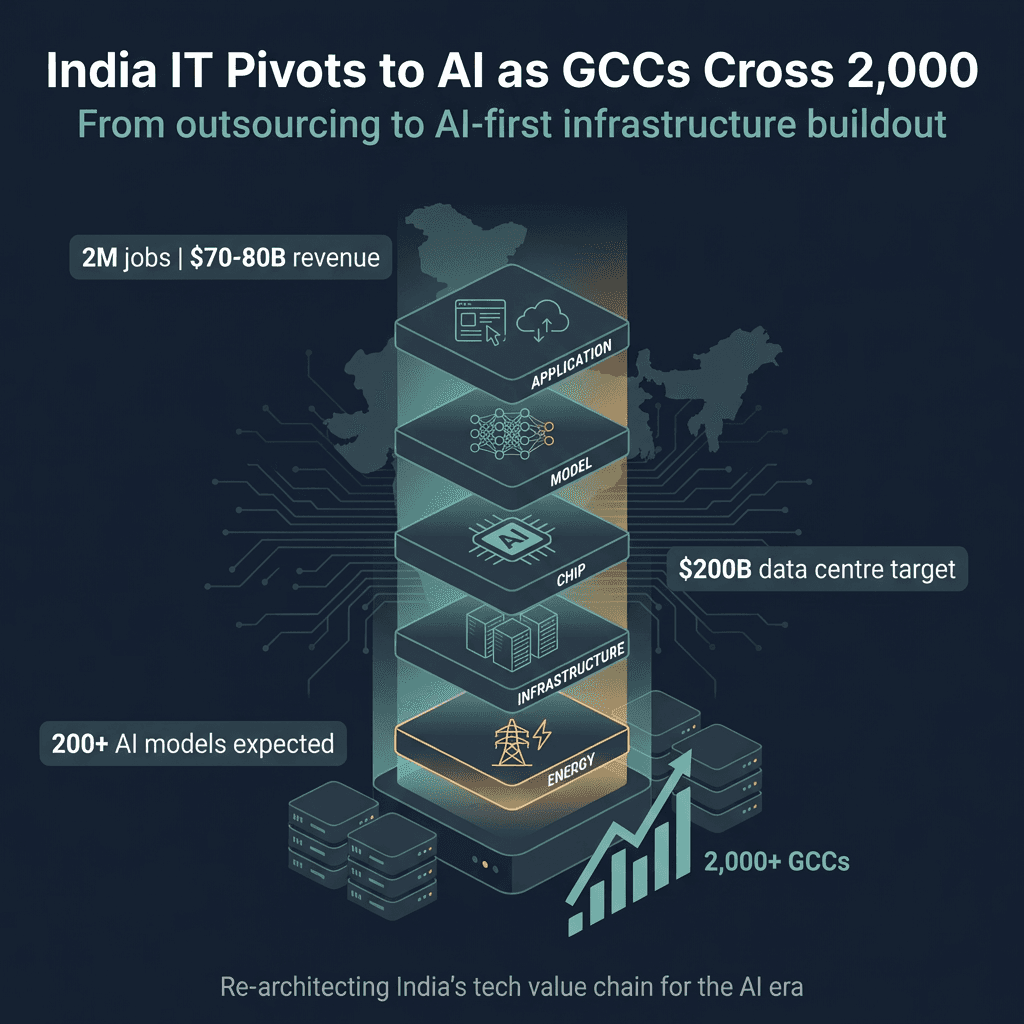
India’s GCC count has grown from roughly 1,700 in 2024 to over 2,000 in early 2026. These centres now:
Employ ~2 million professionals
Contribute an estimated $70–80 billion annually to GDP
Handle end-to-end global product lifecycles
This is not back-office BPO.
This is “Ownership Mode.”
Multinational corporations are no longer using India primarily for cost efficiency. They are building:
AI-driven product R&D
Full-stack engineering teams
Sector-specific AI deployments (shipping, retail, healthcare)
The qualitative shift is clear: GCCs are exporting AI solutions — not just coding services.
The Five-Layer AI Architecture
Vaishnaw outlined what can be described as a “Five-Layer AI Stack” — a national blueprint for AI leadership.
Layer | Focus | Current Status / Target |
|---|---|---|
1. Energy | Sustainable power for compute | 50% green capacity; nuclear exploration for data centres |
2. Infrastructure | Data centres | $200B investment target; tax holiday until 2047 |
3. Chip | Semiconductor design | ISM 2.0 launched; path toward 7nm and eventually 2nm |
4. Model | AI sovereignty | Indigenous models for the Global South |
5. Application | AI-as-a-Service | Transition from software-based to AI-based delivery |
This is a full-stack ambition — from electrons to algorithms to applications.
Data Centres: The Strategic Moat
If AI is the engine, data centres are the power grid.
The Union Budget 2026 introduced key reforms:
Tax holiday until 2047 for foreign cloud providers operating via India-based data centres
Equal tax treatment for domestic and foreign investors
Recognition of data centres as critical national infrastructure
A projected $200 billion investment pipeline
Why this matters:
AI services cannot scale without compute
Data localisation affects latency and compliance
Owning infrastructure reduces strategic dependency
Even if AI models commoditise over time, infrastructure remains defensible.
The “Trifecta” Model: Academia, Industry, Government
To prevent an AI talent gap, the government is pushing synchronization across three pillars:
Academia → Updated AI-ready curriculum
Industry → Standardized skill frameworks
Government → Policy, capital, and infrastructure support
Over 200 engineering colleges have already revised B.Tech and M.Tech programs to include AI and semiconductor engineering. The IT sector is also working toward common AI curriculum standards across its ~10 million talent base.
This coordinated push is designed to pre-empt disruption rather than react to it.
Where This Clashes with the Bearish View
The public markets have not fully bought into this optimism.
Recent commentary around AI suggests:
AI is an extinction-level threat to traditional IT services
CEOs may be underplaying disruption
Valuations do not fully price AI-driven cannibalisation
Vaishnaw’s view differs sharply:
Bearish View | Vaishnaw’s Position |
|---|---|
AI threatens IT survival | AI is a generational opportunity |
Industry is defensive | Structural shift already underway |
IT may go the BlackBerry route | India will reinvent its model |
So who’s right?
Possibly both — at different layers of the ecosystem.
The Uncomfortable Middle Ground for Investors
Here’s the nuance.
1. GCC Growth ≠ Listed IT Profits
GCCs often:
Hire directly
Build captive teams
Reduce reliance on large IT vendors
They are excellent for India’s economy.
They are not automatically positive for TCS or Infosys shareholders.
2. AI Services Are Real — But Margins May Reset
AI-led delivery means:
Fewer people
More output
Faster turnaround
That’s fantastic for clients.
But it threatens:
Billing by headcount
Long-duration manpower contracts
Linear revenue growth models
Revenue may hold.
Margins and valuation multiples may not.
3. Transition Winners Are Not Guaranteed
History offers caution:
Nokia invested heavily
BlackBerry pivoted aggressively
Effort did not equal outcome
In AI, value could accrue faster to:
AI-native firms
GCC-led captive units
Platform-first players
Incumbency is not immunity.
Beyond the Sell-Off: Hardware and Manufacturing
The government’s AI push extends beyond services.
Two global manufacturers have expressed intent to set up AI server manufacturing in India.
A single electronics facility near Bengaluru is projected to employ 40,000 people.
This signals vertical expansion into hardware and advanced electronics manufacturing.
What Should Investors Watch?
This is not a simple buy-or-sell debate.
It is a timing and selection problem.
Indian IT is unlikely to collapse.
But near-term pressure may persist.
Watch for:
Clear AI-led revenue disclosure (not buzzwords)
Margin resilience despite AI-driven efficiency
AI wins beyond cost-takeout automation
Valuations approaching disruption-cycle bottoms
Strategic Conclusion
Vaishnaw is right at the macro level.
India is building across energy, infrastructure, chips, models, and applications. The GCC explosion and data centre push represent a structural re-architecture of the services economy.
But markets price earnings, not strategy.
India may win from AI.
Indian IT companies may survive AI.
Yet investors still need a margin of safety.
The next few years will determine whether legacy giants reinvent themselves — or whether value creation shifts toward AI-native players embedded inside India’s rapidly expanding GCC ecosystem.
And that distinction matters far more than the headline number of 2,000.
Turn insights into informed decisions
Explore research-backed model portfolios and curated stock ideas to make smarter portfolio decisions.
Start Investing