LPG Shortages in Indian Cities
Mar 11, 2026
AdvisorAlpha
Summary
LPG Shortages in Indian Cities Reveal a Deeper Structural Fragility in India’s Energy Supply Chain
Recent LPG shortages across major Indian cities have begun disrupting hotels, restaurants, and small businesses. While authorities have assured that household cooking gas supply remains secure, the ongoing situation highlights something far more significant than a temporary disruption.
India’s LPG shortage is not merely a logistics problem. It exposes a structural vulnerability in the country’s energy supply chain, driven primarily by heavy import dependence and geopolitical risks in West Asia.
If global supply flows do not stabilize quickly, the ripple effects could spread across hospitality, food processing, manufacturing supply chains, and SME vendors.
What Is Happening on the Ground? (As of March 10, 2026)
Across major Indian cities, businesses dependent on commercial LPG cylinders are already facing severe supply disruptions.
Mumbai
LPG refill waiting time has stretched to 2–8 days
Commercial cylinder supplies halted in many areas
Only 10–15% of hotels received fresh supplies
Bengaluru
Only ~10% of hotels and restaurants received LPG supply
Industry associations warn many establishments have gas only until Tuesday
Restaurant closures may begin within days
Kolkata
Distribution of non-domestic cylinders temporarily suspended
Restaurants and bakeries scrambling for alternatives
According to the Federation of Hotel and Restaurant Association of India (FHRAI) and the National Restaurant Association of India (NRAI):
Restaurants are cutting menus and reducing cooking capacity
Many businesses are operating below 50% capacity
Some establishments are resorting to illegal black-market domestic cylinders
Without supply normalization, shutdowns could begin within 1–2 weeks
India’s LPG Problem: A Structural Import Dependency
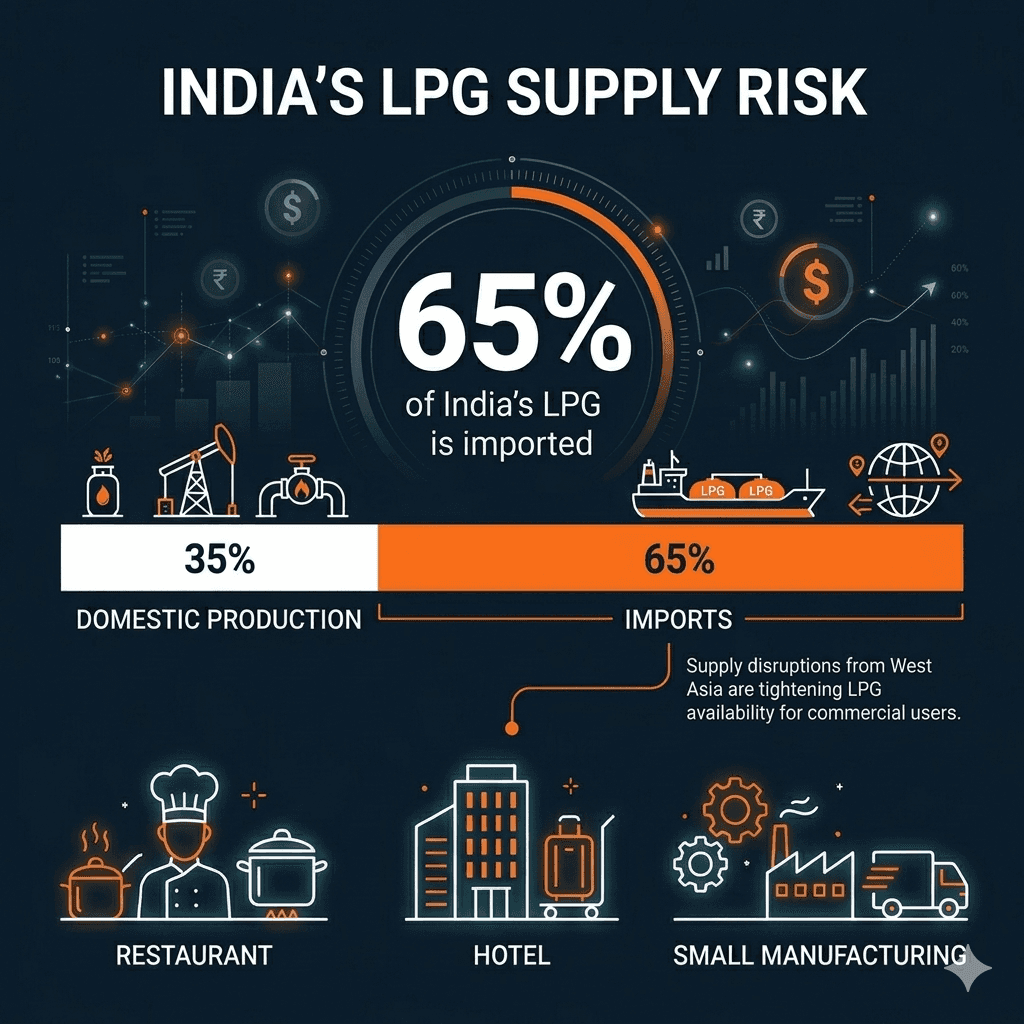
India consumes roughly 31–33 million tonnes of LPG annually, but domestic production accounts for only ~35% of demand.
That means the country imports nearly 65% of its LPG needs.
Most of these imports come from Gulf countries and pass through the Strait of Hormuz, one of the world’s most geopolitically sensitive maritime chokepoints.
Approximately 90%+ of India's LPG imports transit through this route.
When geopolitical tensions disrupt shipping routes, insurance costs, or tanker availability, India’s LPG supply chain immediately becomes vulnerable.
Currently, industry sources indicate LPG inflows through the Strait are operating far below normal levels, sharply tightening supply.
Even if domestic refineries increase output, they cannot bridge the supply gap quickly enough.
Government Prioritization of Household Supply
In response to the tightening supply, the government has prioritized LPG allocation for households.
Residential consumption accounts for nearly 88% of India’s LPG demand, making it politically and socially critical to maintain uninterrupted supply.
Private refiners have reportedly been instructed to route LPG production through state-owned oil marketing companies, including:
Indian Oil Corporation
Bharat Petroleum
Hindustan Petroleum
These companies are prioritizing domestic cylinder distribution, effectively tightening supply for commercial and industrial users.
While authorities say there is no official ban on commercial LPG distribution, the operational reality is that supply for non-domestic segments has shrunk dramatically.
To prevent hoarding, the government has also implemented a 25-day inter-booking period, meaning households cannot order LPG refills more frequently than once every 25 days.
Hospitality Sector Hit First
The hospitality industry is the earliest casualty of LPG shortages.
Hotels, restaurants, and catering businesses depend heavily on commercial LPG cylinders for cooking operations.
As refill delays grow longer:
Businesses are cutting menu items
Kitchens are operating below capacity
Restaurants are reducing operating hours
For many establishments, fuel availability directly determines whether they can remain open.
Without consistent supply, closures may begin within days rather than weeks.
SMEs and Vendor Manufacturing Could Be Next
Small manufacturing vendors may experience the impact slightly later but potentially more severely.
Unlike large industrial companies, small businesses often lack the infrastructure to switch fuels quickly.
Many rely on LPG for processes such as:
Metal welding and brazing
Ceramic firing
Food processing
Textile finishing
Most SMEs maintain only 10–15 days of LPG inventory.
If supplies remain tight, production disruptions could cascade through vendor supply chains, affecting larger manufacturers.
Which Industries Are Most Vulnerable?
Within commercial and industrial LPG demand, the most exposed sectors include:
Hospitality & Food Businesses (40–50%)
Hotels, restaurants, bakeries
Immediate shutdown risk due to lack of substitutes
Metal Processing (15–20%)
Welding and brazing operations
Some ability to shift to electricity
Agriculture & Poultry (10–15%)
Moderate risk due to rural alternatives
Other Manufacturing (20–30%)
Textiles, ceramics, engineering
Some operational flexibility
Among these, hospitality remains the most vulnerable segment, with minimal ability to switch fuels quickly.
India Has Only ~40–45 Days of Inventory Buffer
Even with strict supply prioritization, India’s LPG buffer is limited.
Based on current demand and inventory levels:
Annual demand: ~33 MMT
Inventory coverage: ~25 days normally
Current available inventory: ~40–45 days buffer
This means that even if 100% of LPG supply is directed toward households, shortages could emerge within six weeks if import flows do not normalize.
The Broader Economic Ripple Effect
Energy supply disruptions rarely remain isolated.
The LPG shortage could trigger second-order effects across the economy, including:
Hospitality Revenue Impact
Restaurant closures and reduced operations directly affect employment and tourism.
Vendor Manufacturing Disruptions
SME suppliers facing LPG shortages could interrupt manufacturing supply chains.
Rising Operating Costs
Businesses may be forced to adopt more expensive alternative fuels, increasing operational costs.
Supply Chain Pressure
Industries like packaged foods, textiles, ceramics, and engineering manufacturing could experience cost inflation.
The Hidden Opportunity: Alternative Energy Solutions
Every supply disruption also creates technology and market opportunities.
If LPG shortages persist, demand could rise for companies offering:
Electric cooking systems
Induction cooktops
Solar heating solutions
Renewable thermal energy alternatives
Businesses that help industries reduce LPG dependency may see growing adoption.
Final Thoughts
The current LPG shortage highlights a critical reality: India’s energy security is deeply linked to global geopolitics.
Heavy reliance on imports—especially through a single maritime chokepoint—creates systemic vulnerability.
While the government can temporarily prioritize household supply, structural supply imbalances cannot be resolved without diversifying energy sources, expanding domestic production, and improving strategic reserves.
For investors and policymakers alike, the situation serves as a reminder that energy disruptions rarely stay confined to the energy sector—they quickly ripple across the entire economy.
Turn insights into informed decisions
Explore research-backed model portfolios and curated stock ideas to make smarter portfolio decisions.
Start Investing