Qualcomm’s 2nm Breakthrough: Powering the Next Era of Edge AI
Feb 11, 2026
AdvisorAlpha
Summary
Qualcomm’s 2nm leap boosts edge AI, efficiency, and India’s chip design leadership.
Qualcomm India’s Srini Maddali discusses the significance of the 2-nanometre milestone — its capabilities, real-world use cases, and the competitive differentiation it brings.
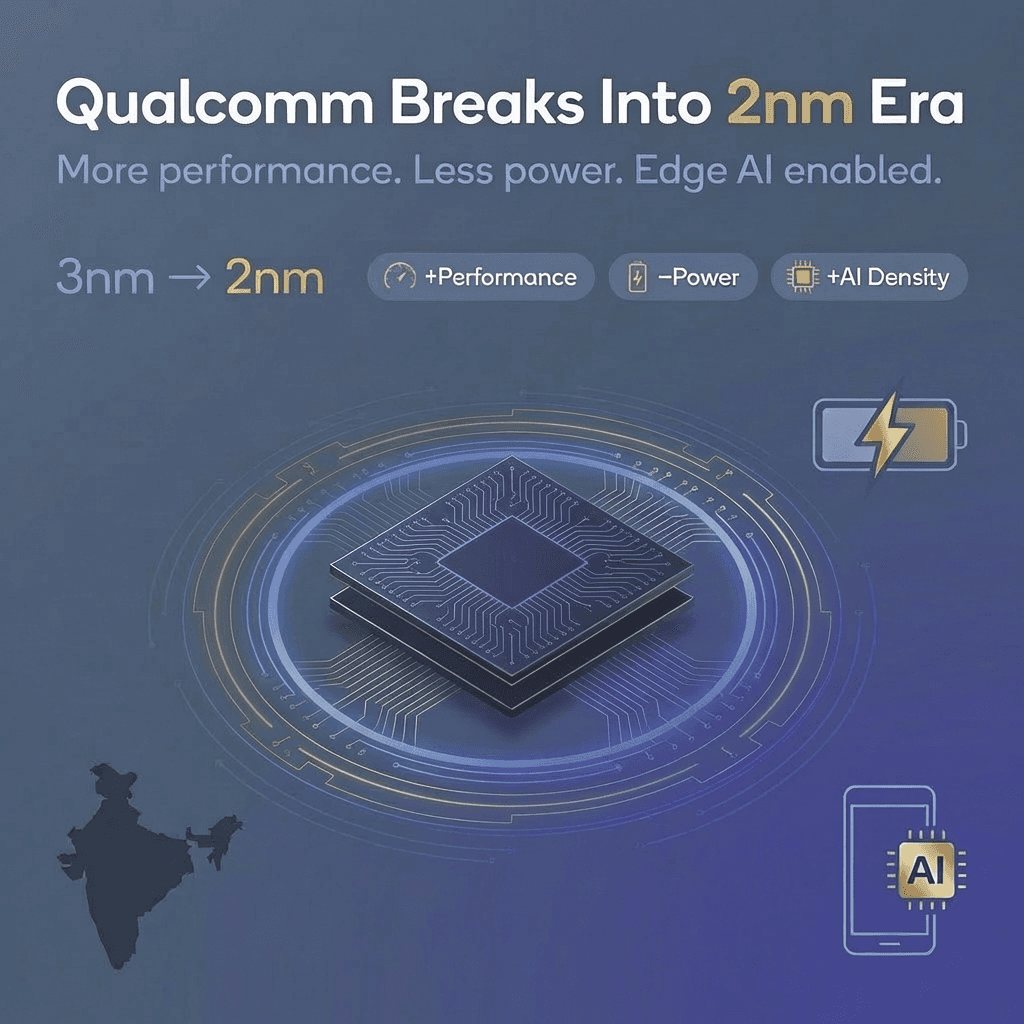
On February 7, 2026, Qualcomm India announced the successful tape-out of its 2-nanometre (2nm) semiconductor design — a major step forward in the global semiconductor race. Led by engineering teams in Bengaluru, Chennai, and Hyderabad, the milestone signals more than just node shrinkage. It represents a strategic shift toward efficiency-per-watt — the core metric that will define the generative AI era.
As the industry transitions from 3nm to 2nm, the breakthrough is less about incremental speed and more about enabling intelligent, always-on AI experiences directly on devices.
Here’s a technical and strategic breakdown of what this milestone means.
1. The 2nm Technical Edge: Beyond Shrinking Wires
While node naming has become more symbolic over time, the move to 2nm represents a genuine architectural leap. It likely marks the industry-wide shift from FinFET transistors to Gate-All-Around (GAA) or nanosheet transistors — a fundamental redesign of how current flows through silicon.
Expected Improvements vs 3nm
Feature | Improvement | Real-World Impact |
|---|---|---|
Performance | +10% to 15% at same power | Faster app launches, smoother gaming, improved multitasking |
Power Efficiency | -25% to 30% at same speed | Significantly longer battery life in smartphones and laptops |
Transistor Density | ~15% higher | More AI cores (NPU), more cache, better on-chip memory |
Cost Scaling | More designs per die area | Advanced features trickle down to mid-range devices |
The headline story isn’t raw clock speed. It’s intelligence per milliwatt — delivering more compute without proportionally increasing power consumption.
2. Enabling Privacy-First Edge AI
The primary beneficiary of 2nm scaling is Edge AI.
Today, many large language models (LLMs) rely on cloud processing, introducing latency and privacy concerns. 2nm silicon changes that equation by making powerful on-device AI feasible.
What This Enables
On-Device Real-Time AI
Higher transistor density allows smartphones and laptops to run complex AI models — including 10-billion parameter class models — locally.
Heterogeneous Compute Orchestration
Qualcomm’s architecture distributes AI workloads intelligently across three key IP blocks:
NPU (Neural Processing Unit): Handles sustained, low-power AI tasks like live translation or generative image creation.
GPU: Manages graphics-heavy AI such as ray tracing or advanced video editing.
CPU: Coordinates logic-heavy and sequential processing tasks.
Hybrid AI Models
For tasks too large to run entirely on-device, workloads can be split — with sensitive data processed locally and heavier computation offloaded to the cloud. This balances performance, privacy, and energy efficiency.
The result: AI assistants that live on your device rather than exclusively in a data center.
3. The “India Design” Milestone
Beyond technology, the 2nm tape-out is strategically significant for India’s semiconductor ambitions.
A Global R&D Powerhouse
Qualcomm’s India workforce is now its largest engineering presence outside the US — and by some measures, globally. The 2nm tape-out validates India’s deep expertise in advanced VLSI design.
Why Tape-Out Matters
“Taping out” is the final design stage before manufacturing begins. Completing this stage within Indian labs signals that the country is no longer just a software services hub — it is contributing at the leading edge of chip architecture.
Toward a Design-to-Assembly Pipeline
Qualcomm CEO Cristiano Amon has expressed interest in leveraging Indian OSAT (Outsourced Semiconductor Assembly and Test) facilities as they mature. If realized, this could create an integrated design-to-assembly semiconductor pipeline within India.
This aligns directly with the goals of the India Semiconductor Mission (ISM 2.0).
4. The Market Context: A Three-Way Sprint
The 2nm race is intensely competitive.
Apple has reportedly secured a significant portion of TSMC’s 2nm production capacity for its upcoming A20 chip in the iPhone 18.
MediaTek has also announced a 2nm Dimensity tape-out.
Qualcomm’s 2nm design is expected to power the Snapdragon 8 Elite Gen 6 for smartphones and Snapdragon X Elite 3 for laptops beginning in late 2026.
The battle isn’t just about performance leadership — it’s about who can define the next AI-native device generation.
Qualcomm 2nm vs China’s AI Chip Progress: A Strategic Comparison
While Qualcomm pushes the physics frontier, China’s semiconductor strategy reflects a different path.
Metric | Qualcomm / Global 2nm | China’s AI/Chip Progress |
|---|---|---|
Process Node Leadership | Leading-edge 2nm with GAA nanosheet transistors and strong PPA (Power, Performance, Area) gains | Domestic production largely around 7nm–14nm, with competitive design innovation |
Performance Gains | 10–30%+ improvements in performance and energy efficiency | Gains driven by architecture and integration rather than node scaling |
Edge AI | Deep NPU integration for generative and real-time AI | Domain-specific edge chips (automotive, IoT) optimized for local efficiency |
Manufacturing Base | Advanced foundries (TSMC, Samsung, Intel) | Domestic fabs improving but constrained by export controls and equipment barriers |
Strategic Focus | Global commercial edge-AI leadership | National self-reliance and ecosystem development |
The Broader Takeaway
Qualcomm’s 2nm breakthrough is a clear advancement in semiconductor physics — translating directly into measurable performance, power, and AI capability gains.
China’s progress, meanwhile, reflects a broader systems-level strategy: strengthening domestic design, deployment, and ecosystem layers even without leading-edge node parity.
Both paths illustrate how global semiconductor competition is evolving:
One strategy pushes transistor scaling to its limits.
The other builds resilience and vertical integration across the technology stack.
In the end, the 2nm milestone is not just about faster chips. It is about laying the hardware foundation for the next generation of intelligent, privacy-aware, AI-native devices.
And that future runs not only through silicon — but increasingly through India’s design labs as well.
Turn insights into informed decisions
Explore research-backed model portfolios and curated stock ideas to make smarter portfolio decisions.
Start Investing