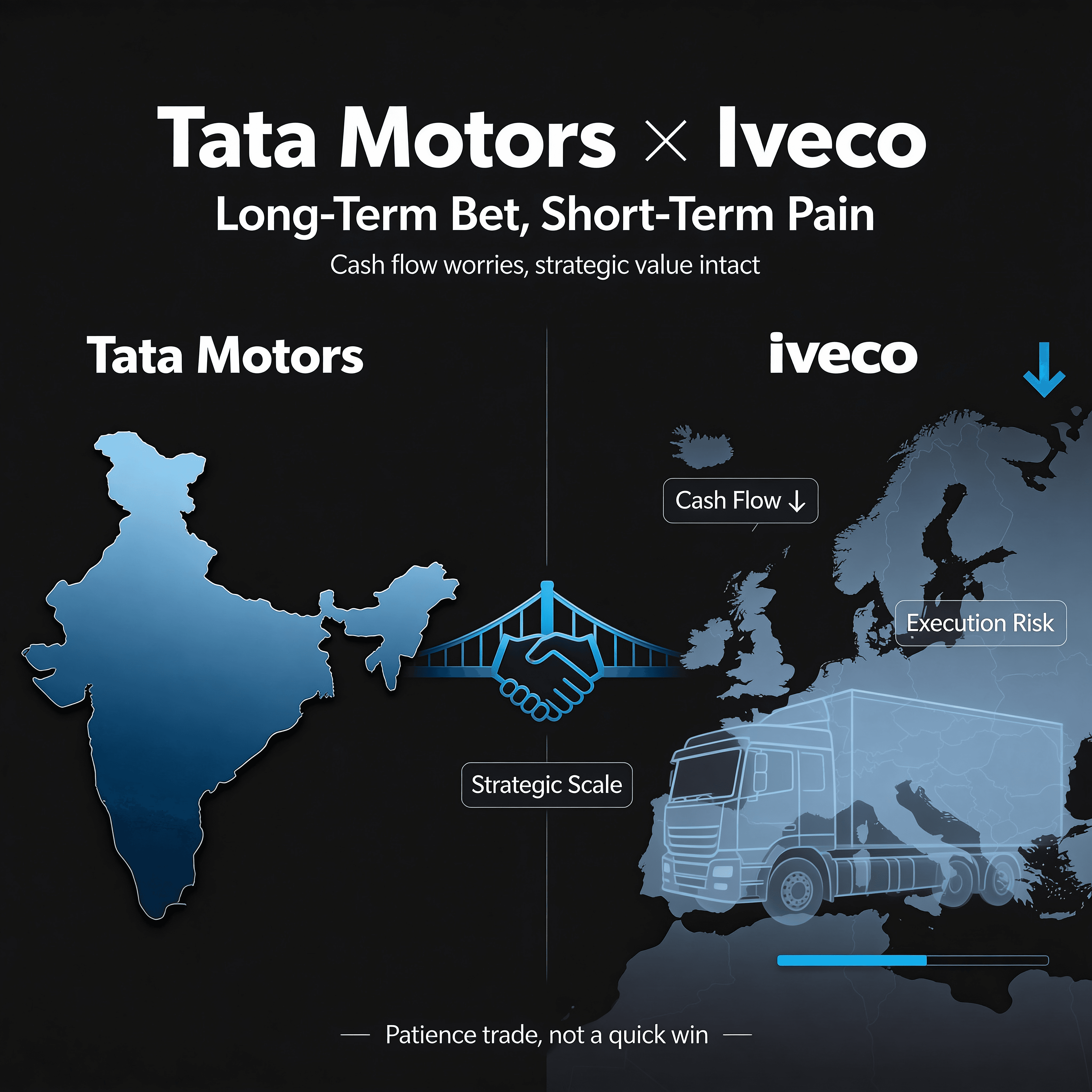
Tata Motors–Iveco Deal:Strategic value outweighing near-term pain
Feb 6, 2026
AdvisorAlpha
Summary
Tata Motors’ Iveco deal offers global scale but near-term cash flow risks may drive volatility.
The recent reports highlighting Tata Motors' $4.4 billion acquisition of Iveco Group underscore a classic "growing pains" scenario for a major cross-border deal. While the long-term strategic logic remains intact for us, the immediate financial volatility at Iveco may test investor patience.
What Triggered the Worry
1) Iveco has slashed its 2025 cash-flow guidance twice in 6 months
o July 2025: Cut to €350–400m from €400–450m (-13%)
o January 2026: Slashed again to just €60m (-82%)
2) Reasons cited:
o Production delays
o Rising costs in the bus segment
o Weak execution in prior quarters
3) The cut impacts commercial vehicles and defence businesses — the very assets Tata Motors is acquiring.
Why This Matters for Tata Motors
1) This is Tata Motors’ largest-ever acquisition at $4.4 billion
2) Tata takes operational control in Q1 FY27
3) A sharp fall in cash generation:
o Raises questions on near-term ROCE
o Increases exposure to European cyclical and cost pressures
o Limits buffer against global slowdown or defence order delays
In short: Tata is buying a business that is strategically attractive, but currently financially unstable.
So Why Isn’t the Market Panicking?
The issues are seen as executional, not structural
1) Iveco still offers:
o Strong European CV footprint
o Access to defence contracts
o Valuable powertrain and EV platforms
2) Tata Motors has a track record of turning around complex global assets (JLR being the poster child)
3) Current problems may actually:
o Improve negotiation leverage
o Set up a lower base for future upside
The Key Risk Going Forward
The real risk isn’t the guidance cut itself — it’s timing.
If:
1) European CV demand weakens further before Tata assumes control, or
2) Cost overruns persist into FY27
then Tata Motors could face:
1) Slower synergy realization
2) Pressure on consolidated cash flows
3) A longer-than-expected payoff period
Bottom Line
1) Near-term: Optics are messy; volatility likely
2) Medium-term: Execution risk is real
3) Long-term: Strategic value outweighing near-term pain
This is shaping up as a “JLR-style patience trade”, not a quick win.
The Core of the Concern: Cash Flow Volatility
The primary "fresh concern" stems from Iveco’s drastic revisions to its Industrial Free Cash Flow (IFCF) guidance for 2025. This metric is critical as it indicates the actual cash available to run operations and pay down debt once the merger is complete.
1) The July 2025 Cut: Originally projected at €400–€450 million, it was first lowered to €350–€400 million shortly after the deal announcement.
2) The January 2026 Cut: Guidance was slashed by 82% to just €60 million.
3) The Culprit: Iveco cited significant production delays and ramp-up costs within its bus segment, alongside a generally weak performance in the previous quarters.
Strategic Context: Why Tata is Still Pushing Forward
Despite these red flags, the deal is viewed as a "global powerhouse" move, often compared to the scale of the 2008 Jaguar Land Rover (JLR) acquisition.
Feature | Details |
Deal Value | Approximately $4.4 billion (€3.8 billion) all-cash offer. |
Excluded Assets | Iveco’s Defence Business (sold separately to Leonardo S.p.A. for €1.7 billion). |
Combined Revenue | Projected to reach €22 billion (~₹2,00,000 crore). |
Timeline | Completion expected in the June quarter of FY 2026-27. |
Our Perspectives:
1) The Bear Case: Iveco's sensitivity to European headwinds and its recent margin squeeze (dropping from 6.9% to 5.1% in Industrial Activities) could leave Tata Motors vulnerable during a global slowdown.
2) The Bull Case: Synergies in EV technology, hydrogen powertrains, and global market access outweigh the temporary cash flow dip.
Key Takeaway: Tata Motors is essentially buying a seat at the "global top table" of commercial vehicles, aiming to compete directly with giants like Daimler and Volvo. However, the "clean-up" of Iveco's operational inefficiencies in Europe will likely be Tata’s first major challenge post-acquisition.
Given the fresh concerns over the Iveco guidance cut, there could be a short-term impact on Tata Motors (CV), though the long-term outlook remains largely positive.
Why We are Staying Positive
Despite the "Iveco Scare," most experts believe Tata Motors is better shielded than in previous years:
1) Strong Domestic Base: January 2026 sales were robust, with domestic CV sales jumping 29.1% YoY. This domestic "buffer" helps offset global volatility.
2) Inexpensive Valuation: At current levels, the stock is trading at an EV/EBITDA of roughly 12.5x–13x, which is considered fair compared to its peer, Ashok Leyland.
3) Margin Resilience: Even with the Q3 profit drop (driven by one-time demerger costs), the CV segment's operating margins actually improved to 12.6%.
The Risk on our Thesis
The recent 82% cut in Iveco’s cash flow guidance has validated some skeptical views:
1) "De-rating" Risk: Exposure to Iveco's volatile performance in Europe could lead to a potential de-rating of the stock if global demand doesn't stabilize.
2) Acquisition Debt: While the deal is strategic, the $4.4 billion all-cash offer will initially be funded by debt, which could pressure the balance sheet if Iveco's cash generation remains weak through 2026.
What the Market Is Really Saying
This isn’t a deal-breaker yet — it’s a risk repricing, not a rejection.
The market is asking:
“Can Tata Motors fix Iveco fast enough — and at what cost?”
As long as:
1) Tata Motors’ India CV stays strong
2) The Iveco concerns stay contained, not systemic.
Turn insights into informed decisions
Explore research-backed model portfolios and curated stock ideas to make smarter portfolio decisions.
Start Investing