Why Compute Access Changes Everything for India’s Data Centre Boom
Feb 10, 2026
AdvisorAlpha
Summary
India–US pact unlocks GPU access, cuts costs, and accelerates India’s data centre-led AI growth.
The India–US interim trade agreement signed on February 7, 2026, is being framed as a trade milestone. In reality, its importance lies elsewhere.
This is not just about tariffs or bilateral commerce.
It is about compute access — and that could fundamentally reshape India’s position in the global AI economy.
By explicitly including high-end GPUs and data centre hardware within a bilateral framework for the first time, the pact addresses a long-standing constraint holding India back: scarcity and cost of advanced compute.
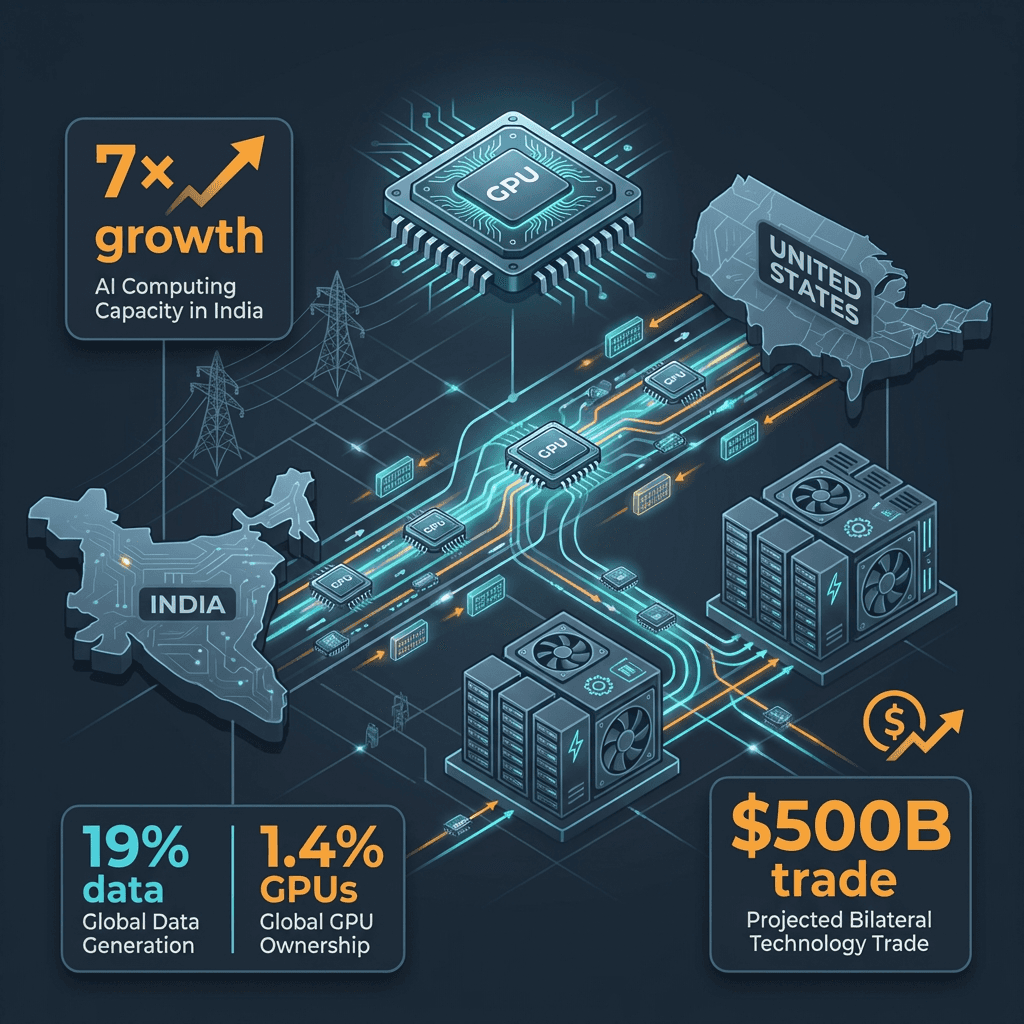
If executed well, this agreement could trigger a multi-year expansion of India’s data centre ecosystem — potentially pushing the market toward a sevenfold increase over the next decade.
What’s Actually New: Compute, Not Commerce
The headline commitment is striking. India has agreed to purchase up to $500 billion worth of US goods over five years. Even if a modest portion — say 8–10% — is allocated to technology and ICT equipment, that translates into $40–50 billion of compute-related imports.
Why this matters:
Improved access to cutting-edge GPUs
Greater certainty around long-term supply
Better pricing competitiveness versus global hubs like Singapore and the UAE
In an AI-driven world, whoever controls compute controls the value chain. This deal directly improves India’s negotiating power on that front.
Why Data Centres Matter More Than IT Services Now
One statistic explains the urgency better than any policy speech:
India produces ~19% of the world’s data
Yet hosts only:
~6% of global data centre capacity
~1.4% of installed enterprise GPUs
That imbalance is not sustainable in an AI-first economy.
The old outsourcing model worked because data could travel cheaply. The new AI model doesn’t. Large models require data and compute to sit close together — for latency, cost, and regulatory reasons.
As a result, capital is rapidly flowing into:
Hyperscale data centres
Dedicated GPU clusters
AI inference and training facilities
This shift, not traditional IT services growth, is what underpins the projections of a sevenfold market expansion.
Is “Sevenfold Growth” Realistic?
Let’s ground the optimism in numbers.
Where the market stands today
India’s data centre market (2025): ~$9 billion
Global share: ~5.5%
What the bull case looks like
Global share rises to ~10%
Market size crosses $12 billion by 2032
The GPU market alone approaches ~$11 billion by the early 2030s
Aggressive? Yes. Implausible? Not necessarily.
Why the math holds:
Hyperscalers have already committed over $80 billion by 2030
AI workloads are overwhelmingly GPU-intensive
Import duties of 20–28% were a genuine cost barrier
Removing friction at the policy level changes project economics rapidly.
The Cost Breakthrough: Why Duties Matter
Until now, importing enterprise-grade GPU servers into India attracted duties that made GPU-as-a-Service nearly 40% more expensive than regional peers.
The trade pact signals a move toward rationalised or zero duties.
What that unlocks:
Around 14% reduction in capex for a 10 MW GPU-ready data centre
Savings of roughly ₹400 crore per facility
Global price parity for Indian startups accessing top-tier GPUs
This directly reduces the incentive for “compute migration” to overseas clouds.
The Sovereignty Question: Avoiding a Compute Colony
While industry bodies welcomed the deal, they also raised a critical warning.
Access alone is not enough.
If India only hosts hardware while:
IP is created elsewhere
Models are trained offshore
Profits accrue globally
then the country risks becoming a low-margin compute host, not a value creator.
This is why stakeholders are pushing for:
Temporary zero import duties
A dedicated PLI scheme for AI hardware
Accelerated depreciation for infrastructure
Clear rules around cross-border compute usage
The objective is not just scale, but value retention.
GPUs Are the New Currency
One number puts things into perspective:
Over the next five years, 18–20 million enterprise GPUs — worth roughly $1.3 trillion — are expected to be deployed globally.
India’s ambition is bold:
Increase global GPU share from 1.4% to ~10%
Move from the 7th to the 3rd largest market
If even part of this materialises, India transitions from being a labour exporter to a compute exporter. That is a structural shift, not a cyclical one.
What This Means for Indian IT Stocks
This is where the narrative becomes uncomfortable.
Clear beneficiaries:
Data centre operators
Infrastructure and EPC players
Power, cooling, and real estate providers
Cloud and GPU-as-a-Service firms
Less obvious winners:
Traditional IT services companies
More compute does not automatically mean more billing. In fact:
AI compresses human effort
Enterprises build in-house AI teams
GCCs reduce dependence on external vendors
This makes the shift positive for India Inc, but neutral to negative for legacy IT margins.
Who Gains from the Pact?
The agreement also acts as a procurement roadmap for US technology firms.
Hardware & Compute
NVIDIA: Dominant beneficiary, powering India’s near-term GPU expansion
AMD: Gaining traction as a secondary supplier
Cloud Infrastructure
AWS: $35 billion committed
Microsoft Azure: $17 billion focused on public-sector AI
Google Cloud: $15 billion toward localisation
Semiconductor Ecosystem
Intel: Server CPUs and foundry collaboration
Qualcomm: Faster rollout of advanced edge and AI chips
The Big Picture
This pact signals a shift in how India approaches technology partnerships — from transactional imports to deployment-level collaboration.
Compute is becoming the new oil.
Access just improved materially.
At a national level, this is a strategic win.
At an investor level, the opportunity will be far more selective.
The real winners won’t just host machines — they’ll own the economics around them.
Turn insights into informed decisions
Explore research-backed model portfolios and curated stock ideas to make smarter portfolio decisions.
Start Investing