How China Emerged Stronger Despite US Tariffs
Feb 3, 2026
AdvisorAlpha
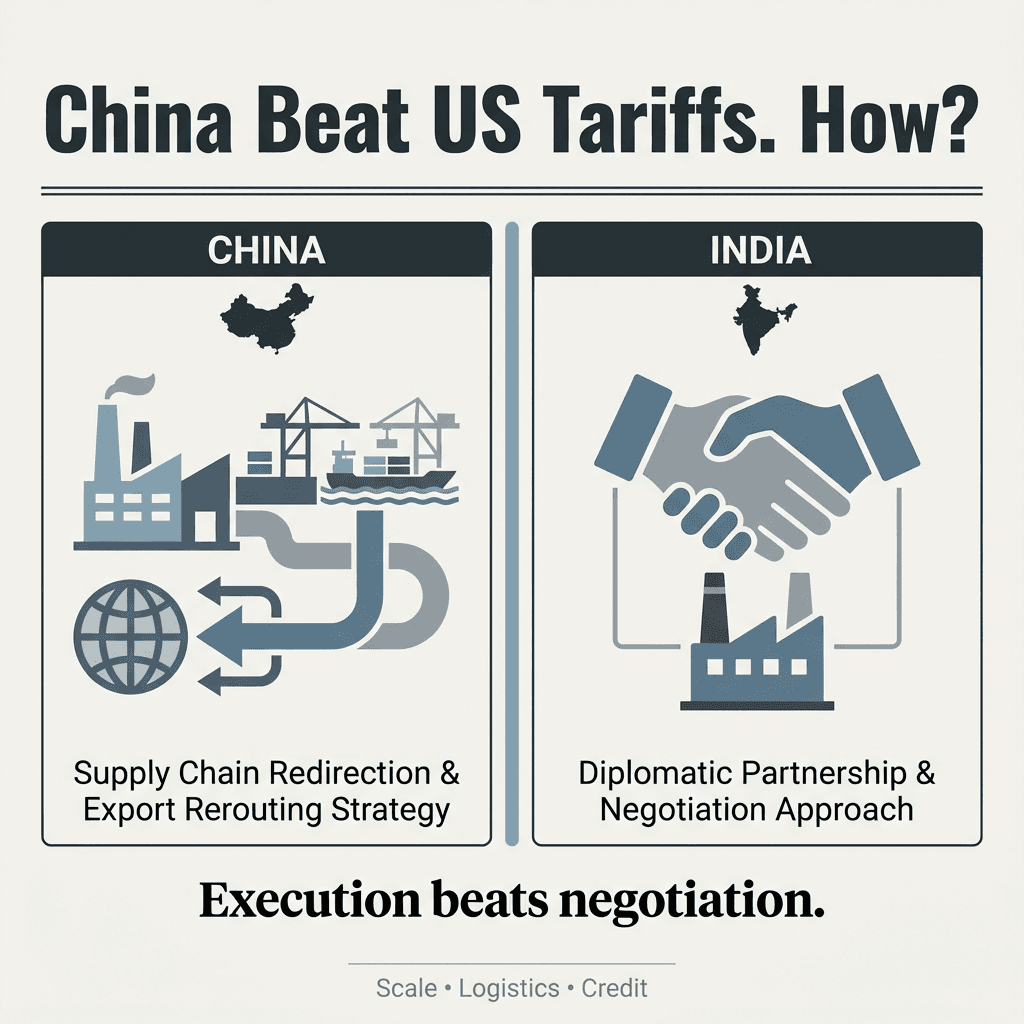
China’s resilience amid aggressive US tariffs wasn’t accidental. It stemmed from what analysts call an “engineering state” model—one that prioritises scale, speed, infrastructure, finance, and execution over slow, rules-heavy processes.
India’s more diplomacy-led trade strategy has strengths, but China’s experience highlights gaps India must urgently address.
Why China Emerged Stronger
1. Strategic Agility: Market Switching vs. Diplomatic Hedging
When the US raised tariffs on Chinese goods to a peak of ~145% in 2025, China didn’t just absorb the cost — it rerouted its entire export engine.
China’s Playbook
US tariffs peaked near 145%, later easing to ~30%
Exports to the US fell ~20%
That decline was offset by double-digit growth elsewhere
Total exports still surged
China rapidly redirected trade to:
Africa: +26%
ASEAN: +13.4%
India: +12.8%
EU: +8.4%
Chinese goods also entered the US indirectly via Vietnam and Thailand, blunting the impact of tariffs.
👉 Key edge: Massive scale + logistics strength enabled instant market switching.
India’s Approach
India has leaned heavily on Free Trade Agreements (FTAs)
On January 27, 2026, India signed the so-called “mother of all deals” with the EU
The agreement could double India–EU trade by 2032
👉 The Lesson:
Diplomacy creates access, but engineering creates agility.
China’s ability to switch markets rests on superior logistics — ports like Qingdao move goods faster and cheaper than any global peer.
2. Competitive Capability: Owning the “Indispensable”
Dominance in High-Growth Sectors
China dominates sectors where global demand is structural, not cyclical, insulating it from bilateral trade shocks.
China leads in:
Smartphones & consumer electronics
Telecom equipment
EVs, batteries, solar & wind technology
Rare earths (exports hit multi-year highs in 2025)
👉 Lesson for India:
Export resilience comes from owning indispensable sectors, not just negotiating lower tariffs.
From “World’s Factory” to Ecosystem Owner
China has moved far beyond toys and low-value manufacturing.
In 2025, China became the world’s largest car exporter (6+ million units), led by EVs
It briefly curtailed rare-earth exports, signalling strategic leverage over Washington
Supply chains were not just efficient — they were weaponisable
India’s Shift
India’s electronics exports surged 35% in FY26, driven by smartphones
But India still remains largely an assembly hub, not a component master
👉 The gap isn’t volume — it’s depth.
3. The “Credit Gap”: Financing Export Scale
This is perhaps the starkest contrast between India and China — and a major hurdle for Indian MSMEs.
The Numbers
Metric | China (2025–26) | India (2025–26) |
|---|---|---|
Domestic finance to private sector (% of GDP) | ~194% | ~50% |
Key advantage | Low cost of capital; long payment cycles | High borrowing costs; limited exporter credit |
Why Credit Matters
Exporting requires:
Long working-capital cycles
Risk hedging
Overseas marketing & distribution
Ability to absorb tariff shocks
👉 Without deep credit markets, scale is impossible.
China’s exporters survive shocks because capital is abundant and cheap.
India’s MSMEs often don’t even get past the starting line.
4. Input Advantage: The Import Paradox
One of China’s most misunderstood strengths is its high-quality imports.
China’s Input-Led Export Strategy
China’s export machine runs on:
Large-scale imports of capital goods & advanced machinery
Deep integration into global value chains
World-class ports, freight corridors & logistics
Competitive exchange-rate management
👉 Counterintuitive insight:
Imports strengthen exports.
China never tried to “self-rely” its way to export dominance.
India’s Challenge and a Quiet Shift
Policies like PLI and Atmanirbhar Bharat were often interpreted as import-unfriendly
This raised costs and hurt MSME competitiveness
📌 Positive signal:
The 2026 Budget rolled back quality-control hurdles on essential inputs, signalling a growing realization:
To export like a champion, you must import like one.
👉 India’s takeaway:
PLI and Atmanirbhar Bharat must enable cheaper, easier access to quality imports, especially for MSMEs.
Where India Should Not Copy China
The Consumption Warning
China’s growth model comes with a vulnerability.
Household consumption: ~39–40% of GDP
Investment: ~40%
Result: Fragility during global slowdowns
India, by contrast:
Consumption-driven economy: ~60% of GDP
Investment: ~30–34%
👉 Critical lesson:
India should boost exports without sacrificing domestic consumption, which acts as a shock absorber during global crises.
Final Take: Engineering State vs. Consumption Hub
China thrives on a surplus-driven, engineering-led model, but now faces a consumption crisis.
India’s strength lies in its domestic demand engine, which cushions global volatility.
The Right Lesson for India
Learn from China’s logistics
Fix credit depth
Embrace input-led competitiveness
Avoid over-dependence on external markets
Expert takeaway:
India doesn’t need to become China.
It needs to become India — with better plumbing.